
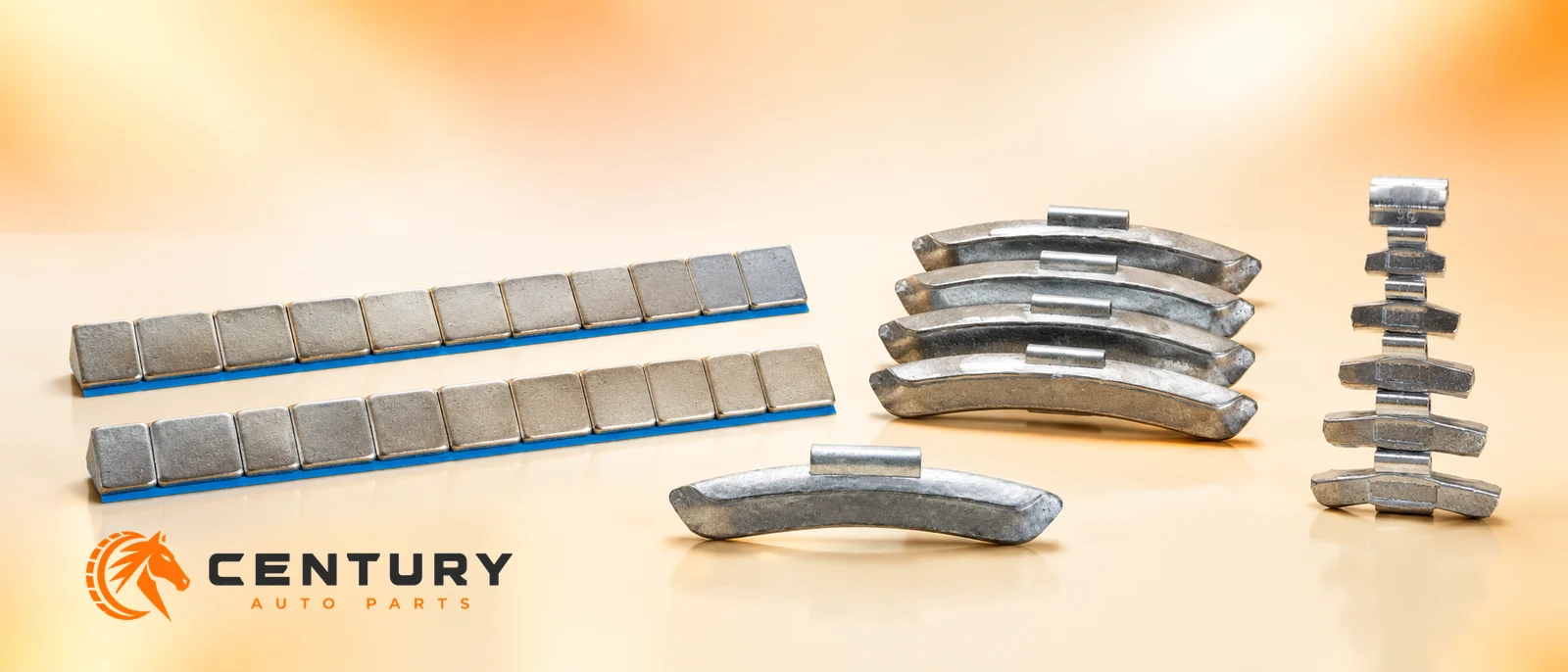
How wheel balancing works is the question behind the quiet part of every tyre service: the machine spins the wheel, finds the heavy spot, and a few small weights cancel it. Understood properly - the physics, the balancing planes, the two weight types and the materials - it becomes a repeat-purchase business for distributors and a confidence-building skill for workshops. This guide walks through the whole process and what to stock.
Why wheels need balancing at all
Every wheel and tyre is manufactured to a tolerance, not to a perfect uniform mass. Several unavoidable sources of imbalance exist even on a brand-new assembly:
- The tyre splice and layout - the joint where the tyre body is joined is slightly denser than the rest of the casing.
- The valve position - a valve stem is a discrete mass fixed at one point on the rim.
- Casting tolerances in the rim - no two points on a cast alloy barrel are perfectly identical in thickness.
- Wheel weights left over - prior balance weights that were never removed before a re-balance.
These small variations in mass are harmless at walking speed but, as the wheel spins faster, they become a centrifugal force that tugs the assembly left and right. That force is what you feel as a vibration through the steering wheel, the seat or the floor at certain road speeds. Balancing adds a controlled mass at the correct position to offset the heavy point, so the wheel re-spins as if it were perfectly uniform.
The two kinds of imbalance: static and dynamic
Understanding balancing comes down to recognising two distinct conditions:
- Static imbalance - a single heavy spot around the wheel circumference. The wheel wants to stop with that heavy point at the bottom, like a wheel with a weight taped to one spot on a car's rim. It causes a vertical bounce.
- Dynamic imbalance - an uneven mass distribution across the wheel's width. Even if the wheel is statically balanced, the two sides (inner and outer planes) can pull in opposite directions, causing a side-to-side wobble at speed.
A proper balancing machine corrects both: it measures the required correction on the inner plane and the outer plane of the wheel separately, because those are the two positions where weights can physically be placed. This is why a technician places weights in two locations, not just one.
What the wheel balancer actually does
A wheel balancer mounts the wheel and tyre assembly, spins it to speed, and measures the resulting force with precision sensors. From that measurement the machine reports two outputs the technician reads directly:
- How much weight to apply - in grams or ounces.
- Where to apply it - the angular position, reported on both the inner and the outer plane.
Modern machines show the technician exactly where to stick or clip each weight (often via a graphic or a laser pointer). The technician applies the weights, re-spins the wheel, and the residual vibration drops toward zero. A wheel is considered balanced when the residual imbalance is within the tolerance the machine (or the vehicle manufacturer) specifies.
The two types of balance weight
Every correction comes down to two attachment methods, each matched to a wheel construction:
| Clip-on | Adhesive (stick-on) | |
|---|---|---|
| Mounting | Spring clip grips the rim flange | Adhesive tape bonds to the inner barrel |
| Best for | Steel wheels, some alloy and truck rims | Alloy and aluminum wheels |
| Position | On the rim edge, both planes possible | Hidden behind the barrel / spokes |
| Typical range | 5g to 500g | 5g to 60g strips (higher for truck adhesive) |
| Rim contact | Contact with the flange | No rim-outer contact - cleaner look |
Steel-wheel fleets overwhelmingly use clip-on weights clipped to the flange, on both balancing planes. Alloy-wheel vehicles - most modern passenger cars - use adhesive strips bonded to the inner barrel so the weights are hidden behind the spokes and never touch the outer rim finish. Some trucks running alloy wheels use the same adhesive logic at much higher masses. The full comparison is in our wheel weight guide.
Materials: Fe, Pb and Zn
Weight material is a buying decision driven by regulation and price point as much as by performance:
- Fe (steel) - the lead-free standard for both clip-on and adhesive weights. Slightly larger than lead for the same mass, but fully compliant and the default for export markets, available zinc plated, epoxy coated or black coated.
- Pb (lead) - the traditional dense material with excellent vibration damping, still widely used where regulation permits and for heavy truck balancing. Restricted or banned in several US states and the EU - see our lead weight bans guide.
- Zn (zinc) - a denser lead-free alternative with strong corrosion resistance for harsh climates.
For a given installed size the balancing mass is identical regardless of material - the choice is about price, compliance and corrosion. The material breakdown is covered in our Fe vs Pb guide.
Sizes, segments and gram vs OZ
Adhesive weights come in segmented strips (5g, 10g, 15g and so on) so the technician can tear off the exact mass the machine asks for. Strip dimensions differ by range - for example a common Fe adhesive strip measures 140 x 19 x 3.8mm - and the segment count varies by model. Clip-on weights are individual pieces in a size series from 5g up, and large truck clip-on weights run to 500g per piece.
Because balancing machines in the US read ounces and most of the world reads grams, the same weights are produced in both series. 1 ounce equals 28.3495 grams. Use our wheel weight conversion chart to order in either convention, and see the adhesive weight sizes guide for strip layouts.
How much weight is typical?
There is no single answer - it depends on the wheel, tyre and position - but a useful planning range for a workshop is that a passenger car balance commonly uses 10g to 60g per wheel, often split between the inner and outer planes. That is why mixed 5g and 10g strips are the most practical adhesive stock item. Truck and commercial balancing needs are far larger, running to 500g per piece on steel rims - see our truck wheel weights guide.
Installation: the part that decides whether it holds
Weights only balance if they stay put at speed, and most failures are installation errors, not product defects:
- Clip-on - the clip profile must match the rim flange. A clip that is too loose will not grip; one that is too tight can damage the rim edge. Match the profile to the steel wheel, alloy wheel or truck rim you are serving.
- Adhesive - the inner barrel must be cleaned with isopropyl alcohol, allowed to dry, and the weight pressed firmly for several seconds. Surface temperature above about 15 C is required for the adhesive to wet out. Follow the full installation checklist to avoid weights that fall off later.
- Tape grade - premium 3M or Norton tape handles heat and cold better than generic tape. For hot climates or commercial wear, specify the better tape. The options are compared in our wheel weight tape guide.
A weight that flies off at speed is a liability for the driver and a warranty problem for the balancer - so surface prep and clip fit matter as much as the mass itself.
Stocking for workshops and fleets
For distributors and fleet suppliers, the practical balance range combines both families:
- Clip-on in the common sizes, in Fe (lead-free) and, where allowed, Pb for trucks.
- Adhesive strips in mixed 5g/10g segments with premium tape, in the strip size your customers' machines most often call for.
- Both gram and OZ series if you export - US workshops balance in ounces.
- Finishes - zinc plated, epoxy or black coated to match the rim and corrosion requirements of the market.
Century Auto Parts supplies clip-on and adhesive weights from 5g to 500g, in gram and OZ series, across Fe and Pb ranges with the full finish and tape options. Browse the wheel balancing weights range, check the material guide, or ask for a wholesale quotation.
Reading the balancer result and tolerance
After the first spin the machine shows the correction on each plane, usually in grams. The technician splits that correction into the segments available - a 15g call becomes a 10g plus a 5g segment torn from a strip. After fitting, the machine re-spins and reports the residual imbalance. A wheel is accepted when that residual falls inside the tolerance the machine or vehicle maker sets, often a small single-digit gram figure per plane. Chasing a zero reading is not necessary and wastes weights; the target is "inside tolerance", not "perfect". On the outer plane the technician also has to respect the rim design - on an alloy wheel there may be no outer flange to clip to, which is exactly why adhesive weights exist.
Adhesive placement: inner barrel and behind the spokes
Adhesive weights are placed on the inner barrel of the wheel, out of sight behind the spokes, so the outer face stays clean. Some machines support a "hidden weight" mode that calculates the split between two positions on the inner barrel so the correction is invisible from outside. That is why adhesive strips are narrow and segmented: they must follow the barrel curve and be torn to the exact gram the machine asks for, while still bonding flat enough to hold at speed. Getting that placement right is a training issue, and it is the single biggest reason a shop's adhesive re-balance either lasts or fails.
Balancing is not the same as wheel alignment
Two different jobs get confused constantly at the counter. Wheel balancing corrects the mass distribution of the wheel-and-tyre assembly so it spins without vibration - it is done with the wheel off the car on a balancer. Wheel alignment adjusts the angles of the suspension (camber, caster, toe) so the wheels point correctly relative to the road - it is done with the car on a lift and does not use balance weights at all. A vibration at speed points to balancing; a pull to one side or uneven tyre wear points to alignment. Selling the right one matters, because a customer who buys weights to fix a pull will come back unhappy.
When a wheel needs re-balancing
Balancing is not a one-time job. A wheel assembly should be balanced or checked whenever:
- A new tyre is fitted, or a tyre is repaired and remounted.
- A weight is lost (knocked off a kerb, or an adhesive strip lifts).
- The driver reports vibration at a specific speed band - commonly 80-120 km/h.
- Wheels are rotated or swapped between positions.
- A wheel or rim has taken an impact.
Because a lost weight is one of the most common causes of a returning vibration, stocking enough mixed strips and clips to re-balance quickly is what keeps a workshop's turnaround tight.
Road-force balancing and the limits of spin balancing
Standard spin balancing corrects mass imbalance, but it cannot see a tyre that is round but stiff in one spot - a condition that produces a vibration even when the mass balance is perfect. Road-force balancing presses a roller against the spinning tyre to measure force variation and can match a stiff spot on the tyre to a low spot on the rim. That is an advanced service, not a replacement for weights, but it explains why a few vehicles still vibrate after a perfect balance: the issue is tyre uniformity, not missing weight.
Common balancing mistakes at the workshop
- Reusing old weights - leftover weights from a previous balance skew the starting point. Always strip the old weights before re-balancing.
- Wrong clip profile - a clip that does not match the flange either will not hold or will damage the rim edge.
- Dirty barrel before adhesive - dust, brake residue or moisture stops the tape from bonding. Clean with alcohol and let it dry.
- Cold adhesive - below roughly 15 C the tape will not wet out properly, and the weight lifts in service. Warm the barrel or the workshop first.
- Balancing a damaged rim - a bent rim cannot be balanced out; the wheel should be repaired or replaced first.
Why this matters for distributors
For a distributor, wheel weights are a high-turnover consumable: every tyre change and every re-balance uses a few grams, so the volume is steady and predictable. The commercial skill is in the assortment - carrying the right mix of clip-on and adhesive, Fe and Pb, gram and OZ, plus the finishes and tape grades that match the markets you serve. Get the assortment right and the reorder is automatic; get it wrong and the workshop goes elsewhere for the one size it needs today.
- Wheel balancing physics and machine practice: standard industry balancing guidance (static/dynamic imbalance, balancing planes)
- Wheel weight types, materials, sizes and finishes: Century Auto Parts published product data
- Unit conversion: 1 oz = 28.3495 g (avoirdupois ounce, international standard)
- State lead wheel weight restrictions: see our lead weight bans guide