
Adhesion failure is the single most common complaint about stick-on wheel weights, and it is almost never the metal that fails. In the vast majority of cases the weight separates from the rim because of what happened before or during installation, or because the tape was not up to the climate it was sold into.
This article is written for distributors and workshops: what causes the failure, how to prevent it, and what to ask a manufacturer before you place an order.
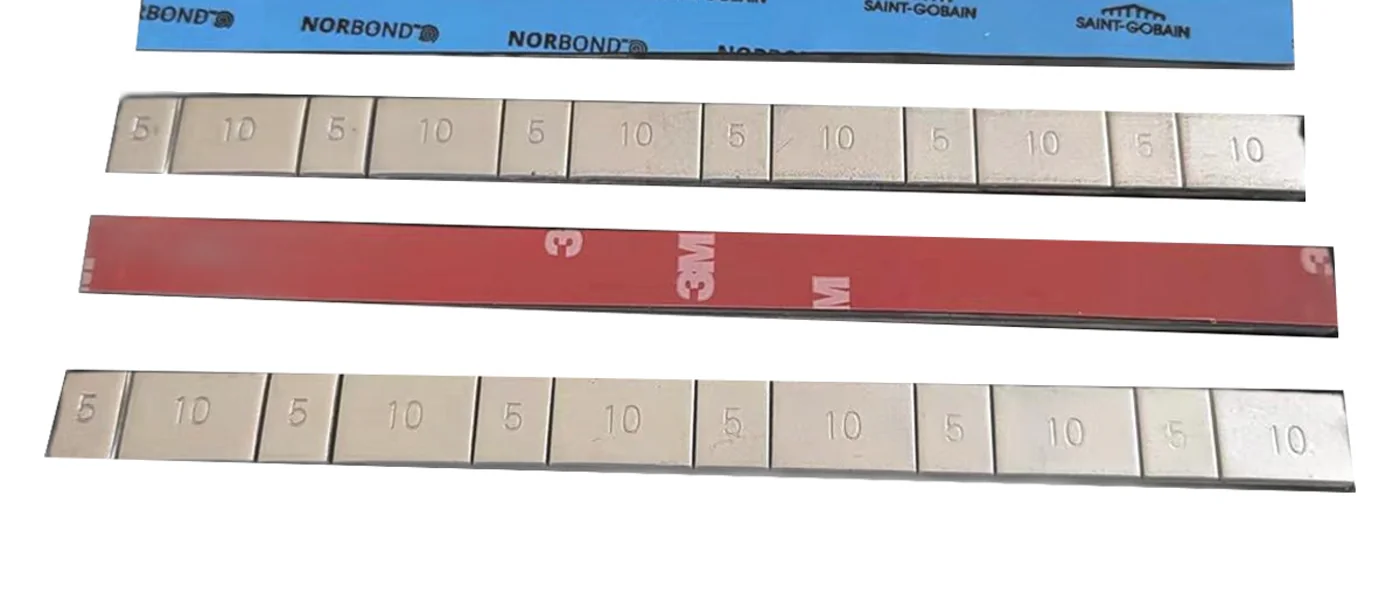
The four failure modes
| Symptom | Root cause | Prevention |
|---|---|---|
| Weight drops off within days | Contaminated surface (dust, tyre sealant, silicone, release agent) | Clean with isopropyl alcohol or a dedicated adhesive remover and let it dry fully |
| Weight slides then falls | Applied cold, so the adhesive never fully wets out | Warm the rim surface before application; avoid outdoor fitting in winter |
| Repeated failures in one market | Economy or unbranded tape sold into a wet or cold climate | Specify 3M or Norton tape for those markets |
| Adhesive stays, weight peels | Porous, dusty or poorly cured rim coating | Test on bare alloy; clean and lightly abrade problematic coatings |
Why tape choice drives failure rates
Pressure-sensitive adhesives are a materials science product, not a commodity. Premium tapes such as 3M and Norton / Saint-Gobain use adhesive systems engineered for low-temperature tack and long-term shear strength on metal. Generic blue tape is a reasonable standard export option, while white or ordinary tape is best limited to hot, dry climates and economy ranges.
For a full breakdown of the options, see our wheel weight tape guide. For the product range itself, see Fe adhesive wheel weights and Pb adhesive wheel weights.
Installation checklist
| Step | Action | Why it matters |
|---|---|---|
| 1 | Remove old weights and all adhesive residue | Old glue is the most common source of contamination |
| 2 | Clean the inner barrel with isopropyl alcohol | Removes silicone, release agents and tyre sealant |
| 3 | Let the surface dry completely | Solvent left on the surface prevents bonding |
| 4 | Work at a surface temperature above about 15 C | Cold surfaces stop the adhesive wetting out |
| 5 | Do not touch the adhesive side | Skin oils cut adhesion dramatically |
| 6 | Press with firm even pressure for several seconds | Adhesion builds with pressure, not just contact |
What to ask your supplier
- Which tape is quoted - 3M, Norton, branded generic or unbranded?
- Peel adhesion data for the tape, tested to a recognised method such as ASTM D3330.
- Salt-spray results for coated surfaces, referenced to a standard such as ASTM B117.
- Samples from the production batch you will actually receive, not a hand-made sample.
Ask for the tape specification in writing with the quotation. It is the single cheapest way to avoid warranty claims later, and it is also why two quotations for apparently identical weights can differ substantially in price - the difference is often in the tape, not the metal.
- ASTM D3330 - standard test method for peel adhesion of pressure-sensitive tape (referenced as the test method to request from suppliers)
- ASTM B117 - standard practice for operating salt spray (fog) apparatus (referenced for coating evaluation)
- Application and surface preparation guidance based on pressure-sensitive adhesive industry practice
- Product and tape options: Century Auto Parts published product specifications