
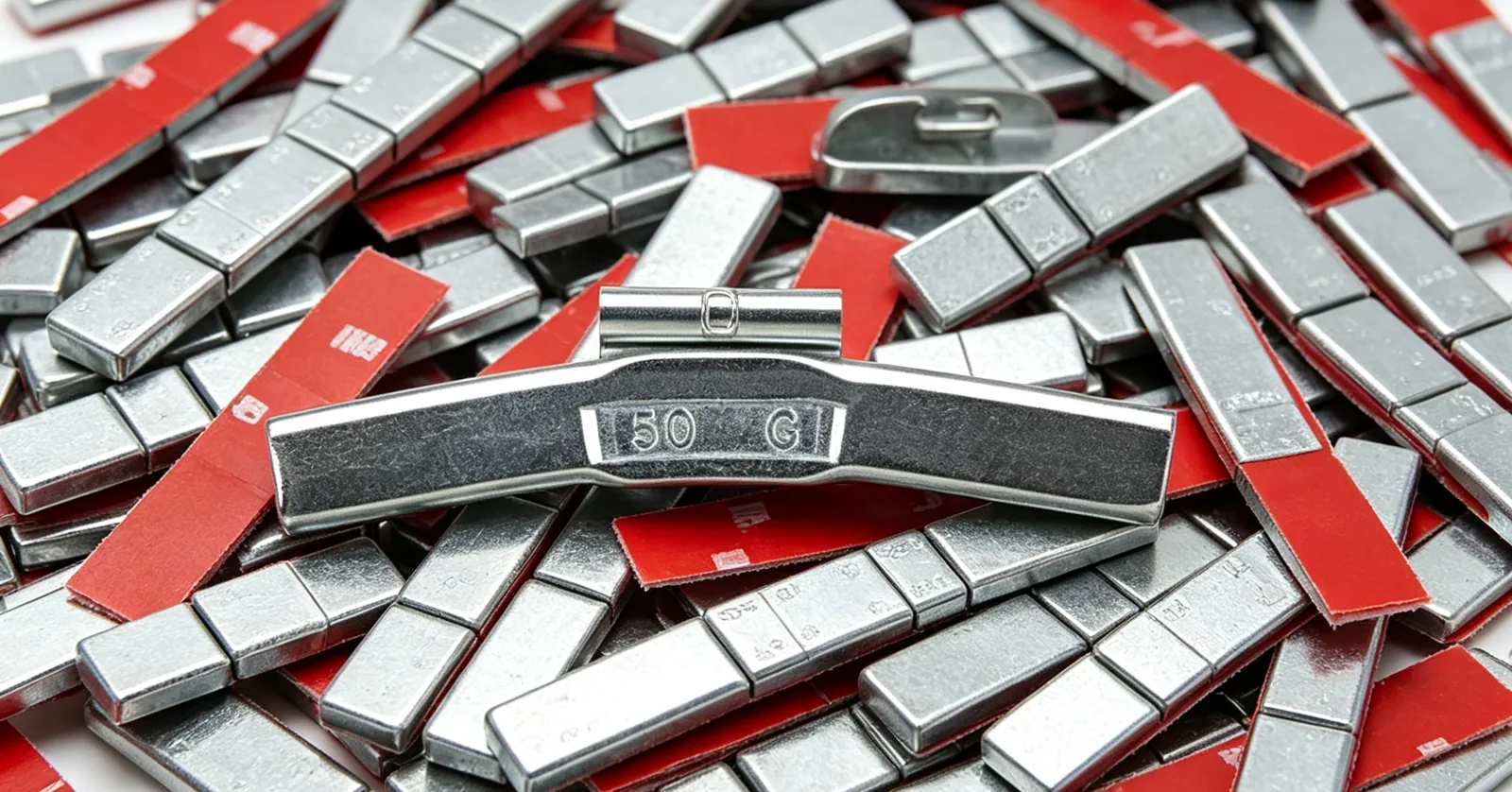
If you source adhesive wheel weights for distribution, you have probably seen the same product sold under several names: adhesive wheel weights, stick-on wheel weights, self-adhesive weights, tape weights and glue weights. They are all the same item - a balancing weight with a pressure-sensitive adhesive backing that mounts on the inner barrel of an alloy wheel.
This guide covers what actually matters when buying them in bulk: materials, tape options, size ranges, packaging and the checks that separate a real manufacturer from a trading company.
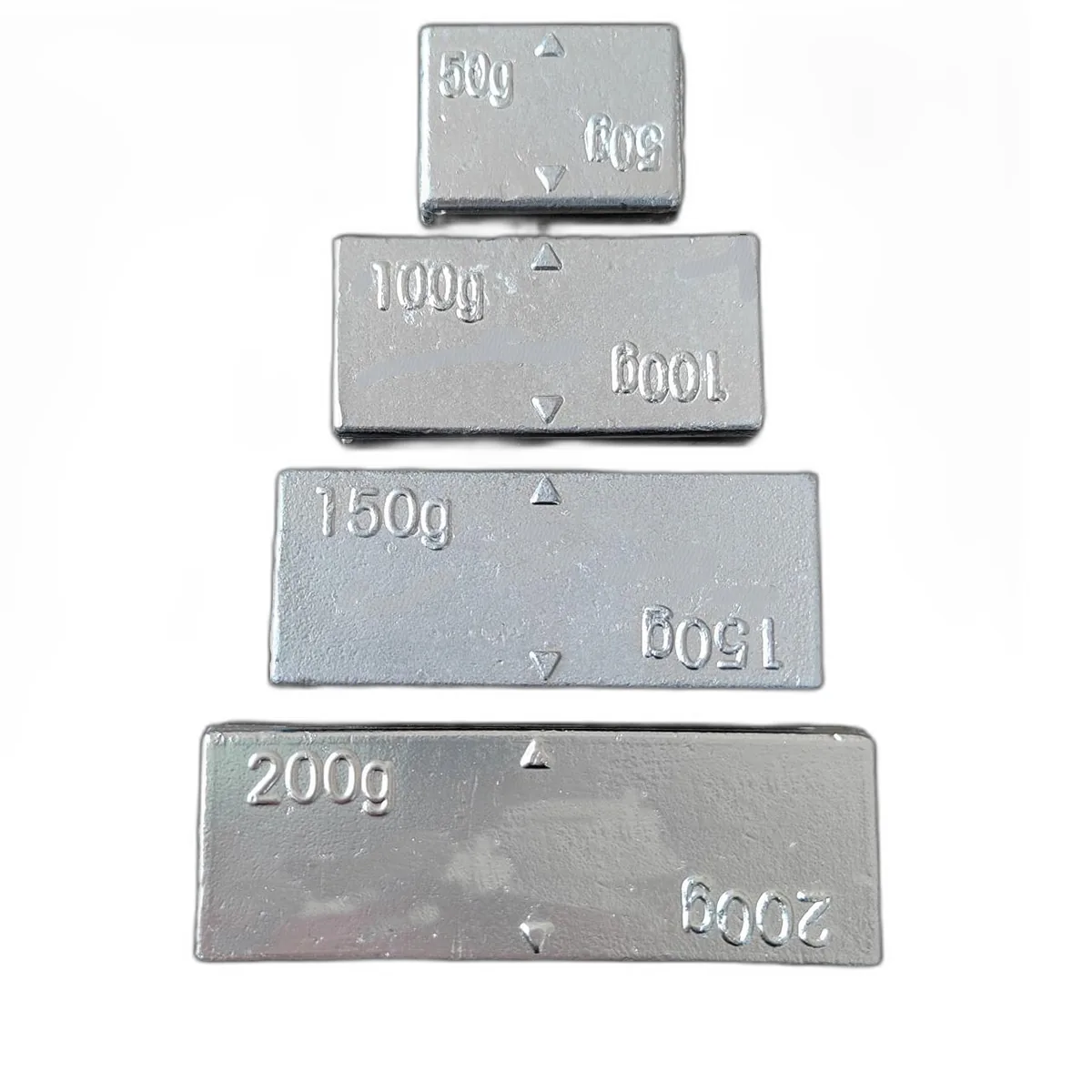
Adhesive vs clip-on: which type are you stocking?
Both types correct the same imbalance, but they mount in different places and suit different wheels.
| Feature | Adhesive (stick-on) | Clip-on |
|---|---|---|
| Mounting position | Inner barrel of the rim | Rim flange (outer edge) |
| Best for | Alloy and aluminum wheels | Steel wheels, some alloy and truck rims |
| Rim contact | No contact with the visible face | Clips onto the flange edge |
| Appearance | Hidden behind the wheel face | Visible on the rim edge |
| Typical weight range | Mainly 5 g to 60 g; higher for truck use | 5 g to 500 g depending on profile |
| Installation | Needs a clean, dry surface | Needs the correct clip profile for the rim |
The rule most workshops follow: steel rims take clip-on weights, alloy rims take adhesive weights. If you are building a balanced range, see our guide to choosing wheel balancing weights.
Materials: Fe, Zn and Pb
| Material | Density | Compliance | Typical positioning |
|---|---|---|---|
| Fe (steel) | About 7.8 g/cm3 | Lead-free; accepted worldwide | Standard range for alloy wheels |
| Zn (zinc) | About 7.1 g/cm3 | Lead-free; strong in Europe | Premium and OE-oriented ranges |
| Pb (lead) | About 11.3 g/cm3 | Restricted or banned in some markets | Legacy markets where still permitted |
Check compliance before you order. Under EU Directive 2000/53/EC on end-of-life vehicles, materials and components of vehicles placed on the market after 1 July 2003 must not contain lead, mercury, cadmium or hexavalent chromium except where they appear on the exemption list in Annex II - and lead in balance weights is one of the entries addressed in that framework, which is reviewed and amended over time. That is why steel and zinc ranges now dominate export demand. Confirm the current rules in your market before committing to a lead (Pb) order.
Tape options: the part that fails first
In service, the tape usually fails before the weight does, so it deserves as much attention as the metal. Most factories offer four options:
| Tape | Liner colour | Positioning | What to check |
|---|---|---|---|
| 3M | Red | Premium range | Ask for genuine 3M material, not re-printed liner |
| Norton / Saint-Gobain | Blue | Premium / OE-oriented | Good alternative to 3M; check liner branding |
| Generic blue tape | Blue | Standard export range | Request peel and salt-spray test data |
| White / ordinary tape | White | Economy range | Suited to hot, dry climates; lowest cost |
When you compare quotations, always ask which tape is included. A lower unit price almost always means a cheaper tape and a higher field failure rate. For a deeper comparison, see our wheel weight tape guide.
Sizes and weight series
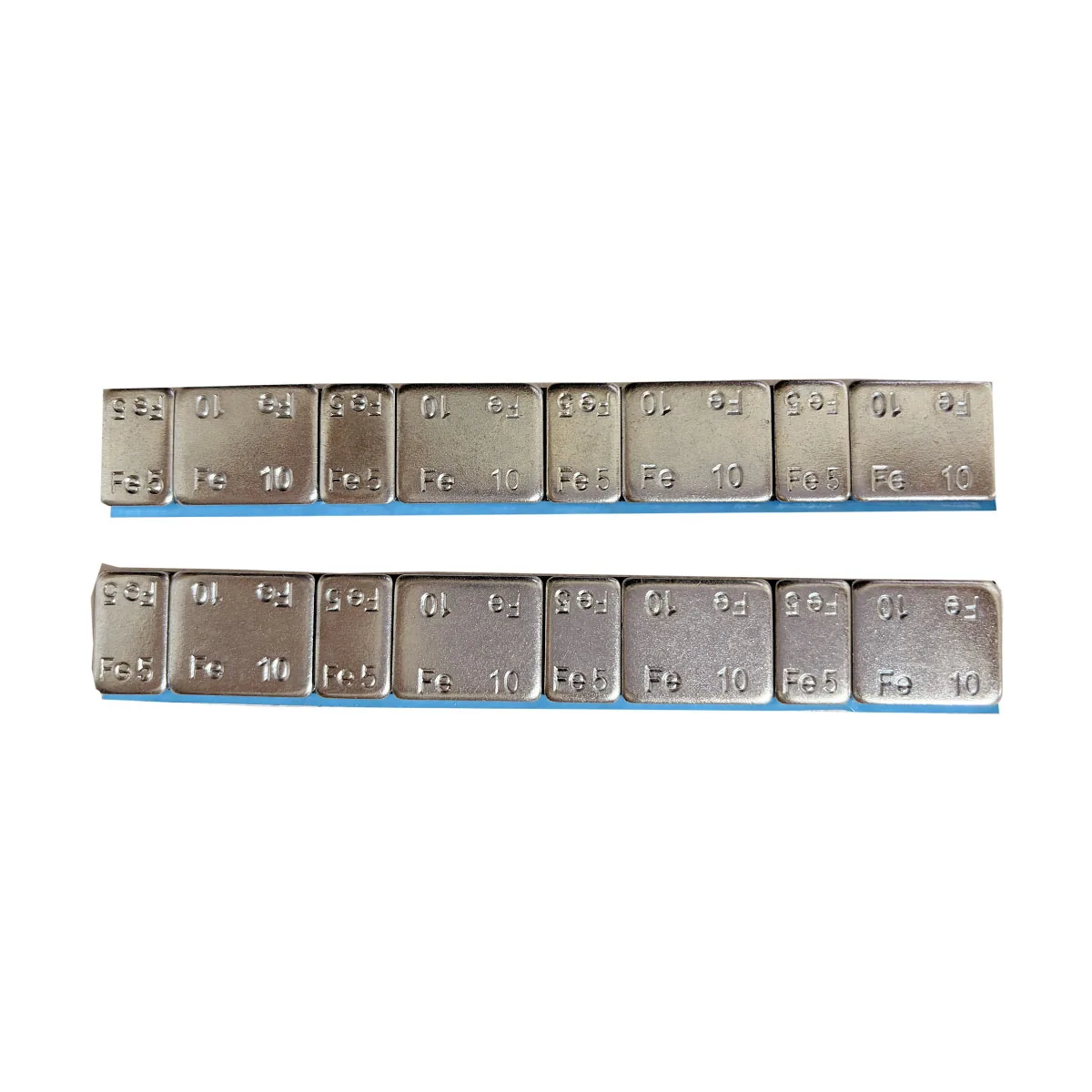
Adhesive weights come as segmented strips that the workshop breaks apart to reach the required mass. The most common gram series run from 5 g to 60 g, with 5 g and 10 g segments used most. Typical dimensions from our own range:
| Model | Material | Configuration | Strip size | Packing |
|---|---|---|---|---|
| CTR-FE-01A | Fe (steel) | 4 x 5 g + 4 x 10 g | 140 x 19 x 3.8 mm | 100 pcs / 50 pcs |
| CTR-FE-02A | Fe (steel) | 12 x 5 g | 140 x 19 x 3.8 mm | 100 pcs / 50 pcs |
| CTR-PB-01A | Pb (lead) | 4 x 5 g + 4 x 10 g | 105 x 18 x 4 mm | 100 pcs / 50 pcs |
| CTR-PB-02A | Pb (lead) | 12 x 5 g | 105 x 18 x 4 mm | 100 pcs / 50 pcs |
Buyers in the US and some export markets order in ounces, so most factories offer both gram and OZ series. For the full conversion chart, see our adhesive wheel weight sizes guide.
What to check before you place an order
- Compliance - confirm which materials your market allows (Fe and Zn are the safe default).
- Certification - ISO 9001 as a baseline; IATF 16949 for OE supply; RoHS and REACH documentation for Europe.
- Tape specification - named tape (3M, Norton) or branded generic, with test data.
- Tolerance - ask for the weight tolerance band and a sample inspection report.
- Adhesion testing - request peel adhesion data (for example to ASTM D3330) and salt-spray results (for example ASTM B117) for coated surfaces.
- Range depth - gram and OZ series, 5 g to 60 g minimum, with round and right-angle profiles.
- Packaging - bulk cartons or retail-ready private label packing.
Where adhesive weights fit in a full range
Most distributors stock adhesive weights alongside clip-on weights so they can serve both alloy and steel wheels. See the wheel balancing weights range, the Fe series and the Pb series, or read how our manufacturing process and export service works. To request a quote, contact our team.
- Directive 2000/53/EC on end-of-life vehicles, Official Journal L 269, 21.10.2000 - eur-lex.europa.eu
- ISO 9001 (quality management) and IATF 16949 (automotive quality) - certification standards referenced for supplier vetting
- ASTM D3330 (peel adhesion of pressure-sensitive tape) and ASTM B117 (salt spray testing) - test methods referenced for tape and coating evaluation
- Product dimensions and configurations: Century Auto Parts published product specifications