
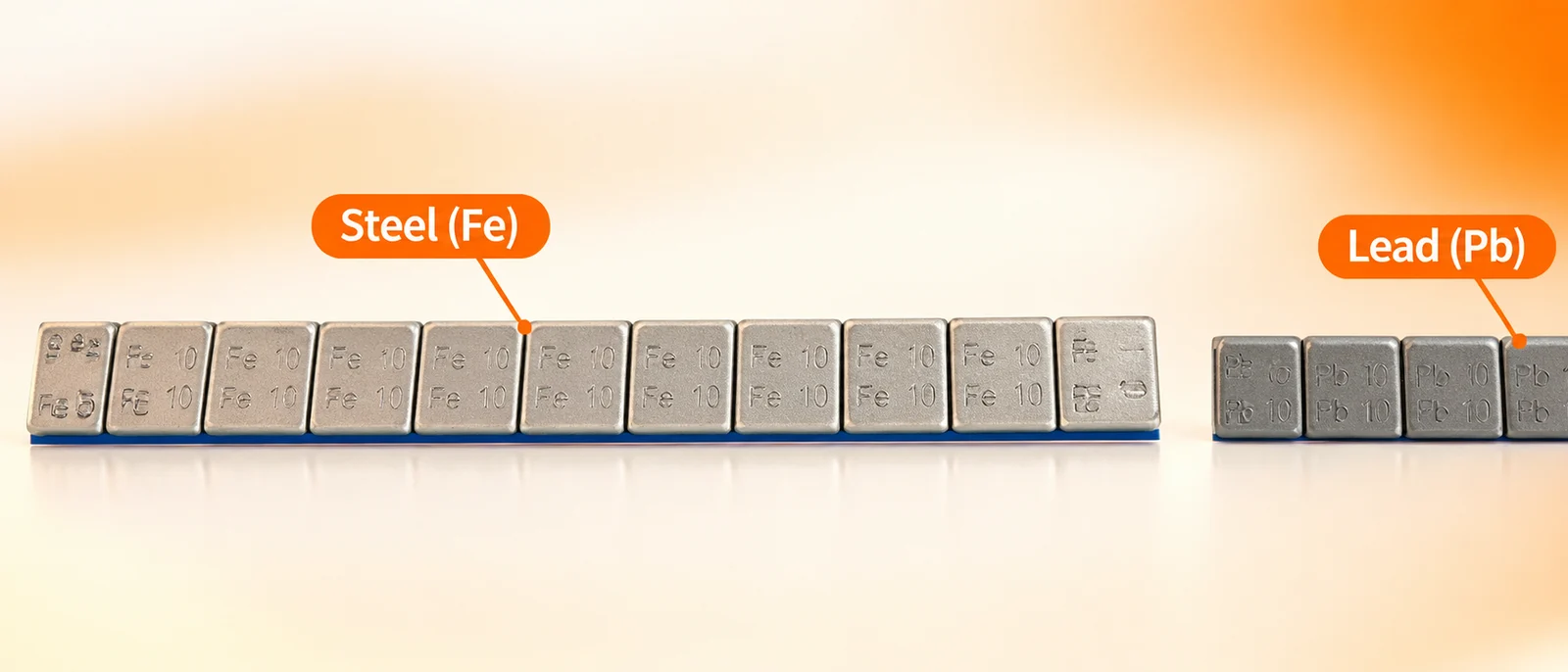
When you specify wheel balancing weights, one of the first decisions is material: Fe (steel) or Pb (lead). Both correct imbalance equally well, but they differ in physical size, compliance, cost and where they can legally be sold. This comparison sets out the trade-offs so you can stock the right range for your market.
The core difference: density
The materials do the same job but weigh differently for their volume, and that shapes everything else:
| Property | Fe (steel) | Pb (lead) |
|---|---|---|
| Density | About 7.8 g/cm³ | About 11.3 g/cm³ |
| Size for the same mass | Larger | Smaller |
| Compliance | Lead-free; accepted worldwide | Restricted or banned in several markets |
| Corrosion protection | Zinc plated, epoxy or black coated | Coated, but lead is inherently soft |
| Relative unit cost | Lower and stable | Higher and subject to regulation risk |
| Typical adhesive strip | 140 x 19 x 3.8 mm | 105 x 18 x 4 mm |
Because lead is denser, a 105 mm lead strip carries a similar mass to a 140 mm steel strip. That compactness was historically lead's main advantage - it fits neatly into tight wheel barrels - but it comes with a compliance problem.
Compliance: the deciding factor
Under EU Directive 2000/53/EC on end-of-life vehicles, materials and components must not contain lead except where listed as an exemption, and lead in balance weights is addressed within that framework. In practice, lead wheel weights are restricted or banned across the EU, the UK, Canada and several US states, and the US EPA runs a voluntary lead-free initiative. The result is that steel, zinc and adhesive weights now dominate export demand.
Practical rule: treat steel and zinc as the safe default and stock lead only for markets where it remains permitted and where customers specifically ask for it. Always confirm the current rules before committing to a lead order - see our adhesive wheel weights buying guide for more compliance detail.
Performance: is there a real difference?
For correcting imbalance, no - a correctly specified weight of the right mass balances the wheel regardless of material. Claims about "better damping" for lead refer to its density and softness, which historically made it forgiving in tight spaces, but they do not change the balancing result. Steel weights with a good coating perform just as well in service.
Cost and supply
- Steel - lower, more stable unit cost, with abundant supply and no regulation risk.
- Zinc - priced above steel but offers premium corrosion resistance for harsh climates.
- Lead - often higher cost per unit and exposed to regulatory risk, which can disrupt supply.
How to choose
- Check legality first. If lead is restricted in your market, stock steel or zinc only.
- Default to steel. Fe is the cost-effective, lead-free standard for most applications.
- Upgrade to zinc for harsh weather, road salt or premium/oE-oriented ranges.
- Use lead only where permitted and where customers request the smaller size for specific wheels.
- Match the type to the wheel. Adhesive for alloy rims, clip-on for steel - see our wheel weight guide.
We manufacture Fe wheel balancing weights and Pb weights in gram and OZ series from 5 g to 500 g. Browse the full wheel balancing weights range or contact our team for a quote.
- Directive 2000/53/EC on end-of-life vehicles, Official Journal L 269, 21.10.2000 - eur-lex.europa.eu
- US EPA National Lead-Free Wheel Weight Initiative - voluntary programme background
- Material densities and product specifications: Century Auto Parts published product data