
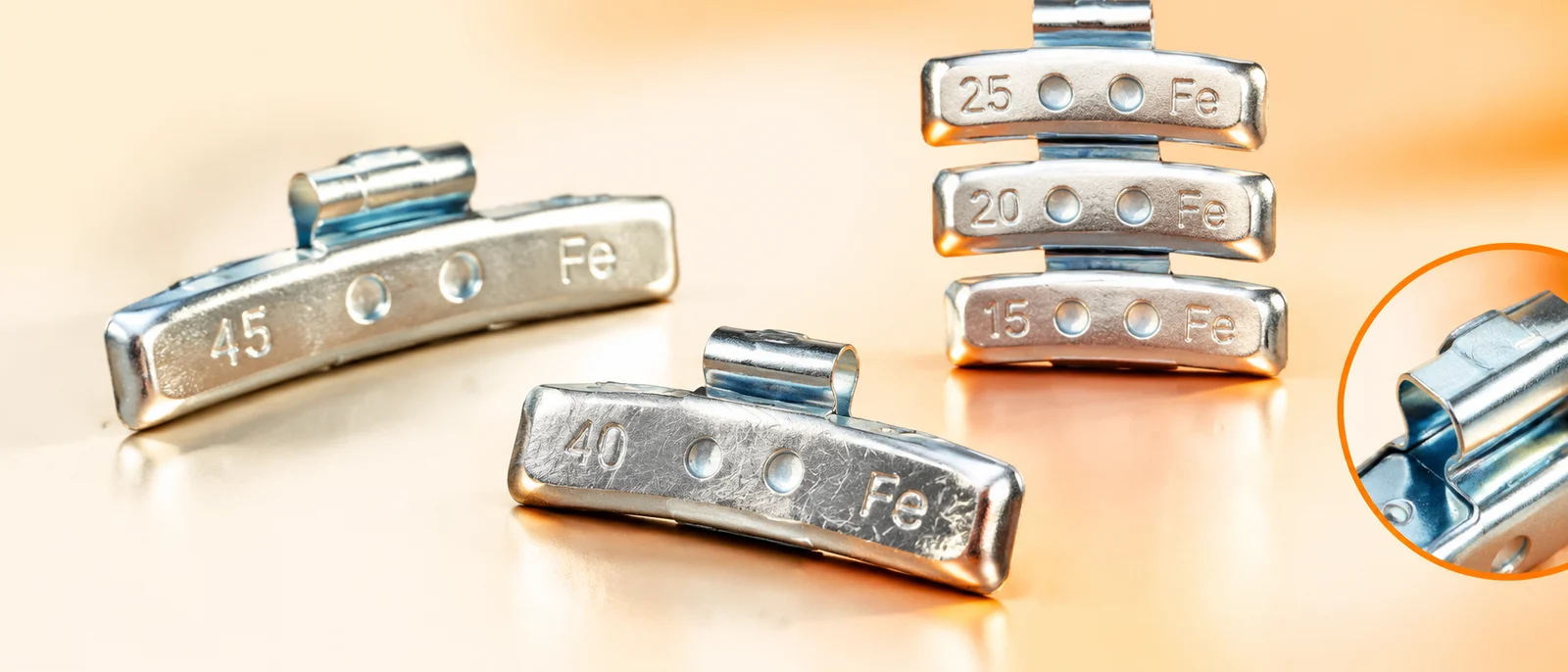
Clip-on wheel weights are simple parts, but they fail in two predictable ways: the clip breaks, or the weight corrodes. Both are usually traceable to a specific cause - and both can be avoided by specifying the right product and fitting it correctly.
Why clips break
- Over-bending during fitting. Springing the clip too far to force it onto a flange stresses the steel and can crack it.
- Poor heat treatment. If the clip is not correctly tempered, the steel is brittle and snaps under load.
- Reusing weights. Re-bending a used clip to fit another rim weakens it and is a leading cause of roadside failures.
- Wrong profile. A mismatched clip forces the fitter to bend it excessively, which shortens its life.
Why weights corrode
Corrosion starts where the coating is missing or thin. The two critical areas are the weight body and the clip cavity - the inside of the clip that is easy to leave uncoated, yet is the part most exposed to trapped moisture.
| Failure | Cause | Prevention |
|---|---|---|
| Rust on the weight face | Thin or damaged coating | Specify zinc-plated, epoxy or black coated weights |
| Rust inside the clip | Uncoated clip cavity | Require full coating including the clip cavity |
| White/grey deposits on alloy rims | Galvanic corrosion at a bare steel contact | Use fully coated clips; avoid bare metal contact |
| Clip cracking | Over-bending or brittle steel | Fit the correct profile; never reuse a bent weight |
Galvanic corrosion: the alloy rim problem
When two different metals touch in the presence of moisture, the less noble one corrodes - a process called galvanic corrosion. A bare steel clip in contact with an alloy rim can leave deposits and pit the rim surface. The fix is simple: use weights whose clips are fully coated, including the cavity, so the metals never make direct electrical contact.
How to prevent failures - buyer checklist
- Specify full coating - weight body and clip cavity.
- Ask for salt-spray data (e.g. ASTM B117) covering both parts.
- Request the clip heat-treatment specification to confirm it is not brittle.
- Match the profile to the rim - see our clip profile guide.
- Train fitters not to reuse weights or over-bend clips.
- Store stock dry and rotate it so older stock is used first.
Specifying a durable weight
A durable clip-on weight has a correctly tempered clip, a full protective coating and the right profile for the wheel. Compare suppliers on these points rather than on price alone - a cheap weight that corrodes or sheds in service costs far more in returns. See our clip-on buying guide and global manufacturer guide for supplier checks, or contact our team for a quote.
- ASTM B117 (salt spray testing) - test method referenced for coating evaluation
- Galvanic corrosion principles for dissimilar metals in contact
- Product coating and clip specifications: Century Auto Parts published product data