
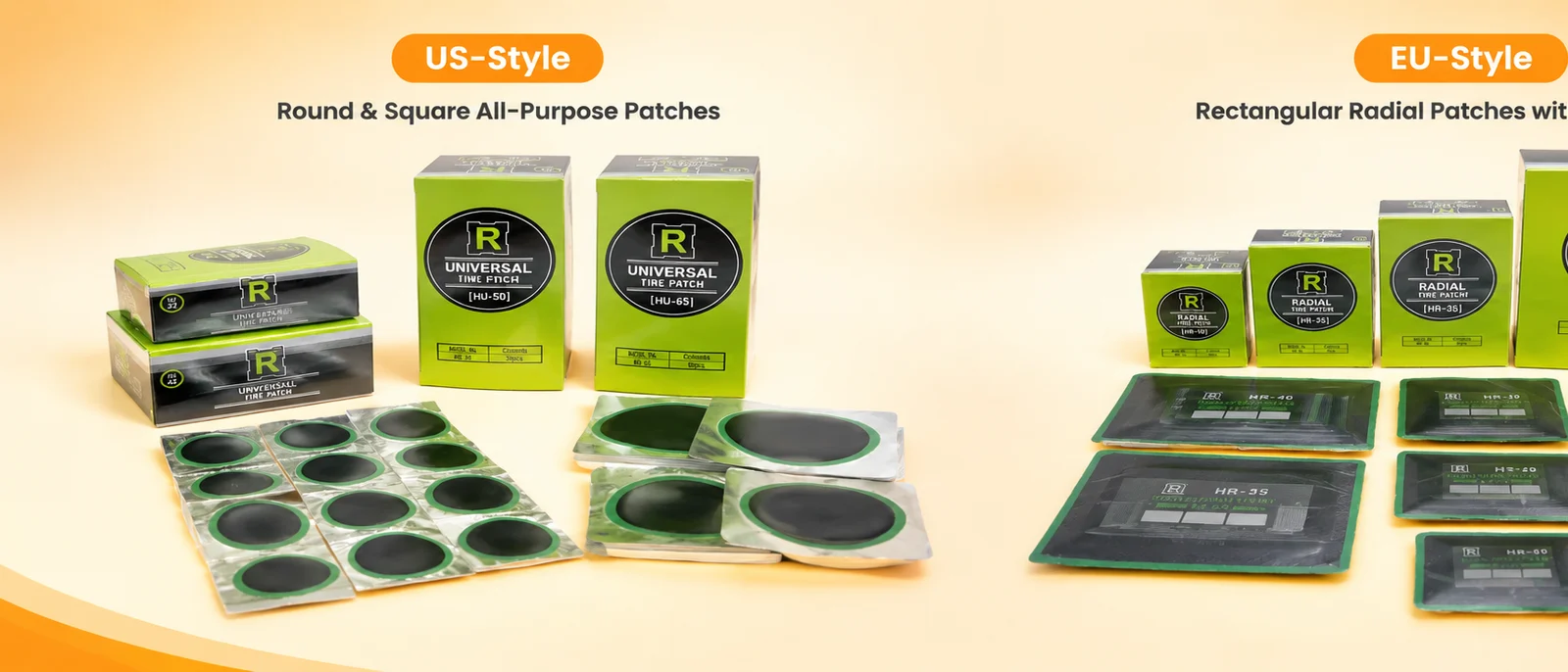
Tyre patches all do the same job - seal an injury from the inside of the tyre - but buyers quickly discover there are two broad families on the market: US-style and EU-style repair patches. They are not interchangeable part numbers, and understanding the difference helps distributors stock the right range for their region and workshops avoid failed repairs.
US-style patches at a glance
US-style patches are the general-purpose and radial patches widely used in North American repair practice. They are commonly supplied as round, square and oval shapes in a numbered series, with a separate heavy-duty sidewall range. Typical types include:
- All-purpose round / square cold patches - the everyday repair patch in sizes from about 35 mm up to 75 mm.
- Black radial patches - reinforced for radial tyres, in round, oval and square shapes.
- Radial sidewall patches (HD) - heavy-duty patches for sidewall-area repairs.
- Bias-ply patches - for traditional bias construction.
See the full US-style tyre patch range, including CTR-TPU-10# to CTR-TPU-116# all-purpose patches.
EU-style patches at a glance
EU-style patches follow the European repair method and are usually specified by PLY rating rather than by shape alone. They are generally rectangular or oval and are chosen to match the injury size and the vehicle category. Typical types include:
- Radial patches (1-4 ply) - for passenger and light commercial radial tyres.
- Bias-ply patches (1-6 ply) - for bias tyres and larger injuries.
- All-purpose round and square patches - general workshop use.
- Inner / sunflower / oval patches - inner-tube and specific-profile repairs.
- Bicycle repair patches - compact patches for cycle tubes.
See the full EU-style tyre patch range, including CTR-TPE radial and bias series.
Key differences compared
| Feature | US-style patch | EU-style patch |
|---|---|---|
| Sizing basis | Shape and nominal size (mm) | PLY rating plus dimensions |
| Common shapes | Round, square, oval | Rectangle, oval, round |
| Typical ply range | Specified by patch type | 1 to 6 ply |
| Typical sizes | 35 mm to 165 mm | 48 x 68 mm up to 180 x 440 mm |
| Heavy-duty options | Sidewall HD range, truck patches | High-ply radial and bias patches |
| Best fit market | North America and general export | Europe and markets using the EU method |
How to choose
- Match your repair standard. If your technicians are trained to the European method, stock EU-style patches with ply ratings; if they use the US method, stock US-style shapes and sizes.
- Match the tyre construction. Use radial patches for radial tyres and bias-ply patches for bias tyres.
- Size to the injury. The patch must overlap the injury with an adequate margin; do not stretch a small patch over a large hole.
- Choose the ply for the duty. Use higher-ply patches for larger injuries, heavier vehicles and higher speed ratings.
- Check the injury limits. Regardless of style, sidewall, shoulder and cord-damaged repairs are restricted - see when a tyre should not be repaired in our patch vs plug guide.
Stocking both ranges
Many distributors stock both families so they can serve workshops using either method. A practical starter range includes all-purpose round patches in a few sizes, radial patches in 2-3 ply options, bias patches for older tyres, and a small sidewall HD selection. Combine these with mushroom patch plugs and tyre seal strings to complete a repair kit. For a factory-direct quote on mixed patch ranges, contact our team.
- BS AU 159 (UK standard for repair of car and light van tyres) and industry repair practice - repair method background
- Product ranges, shapes and ply ratings: Century Auto Parts published product data