
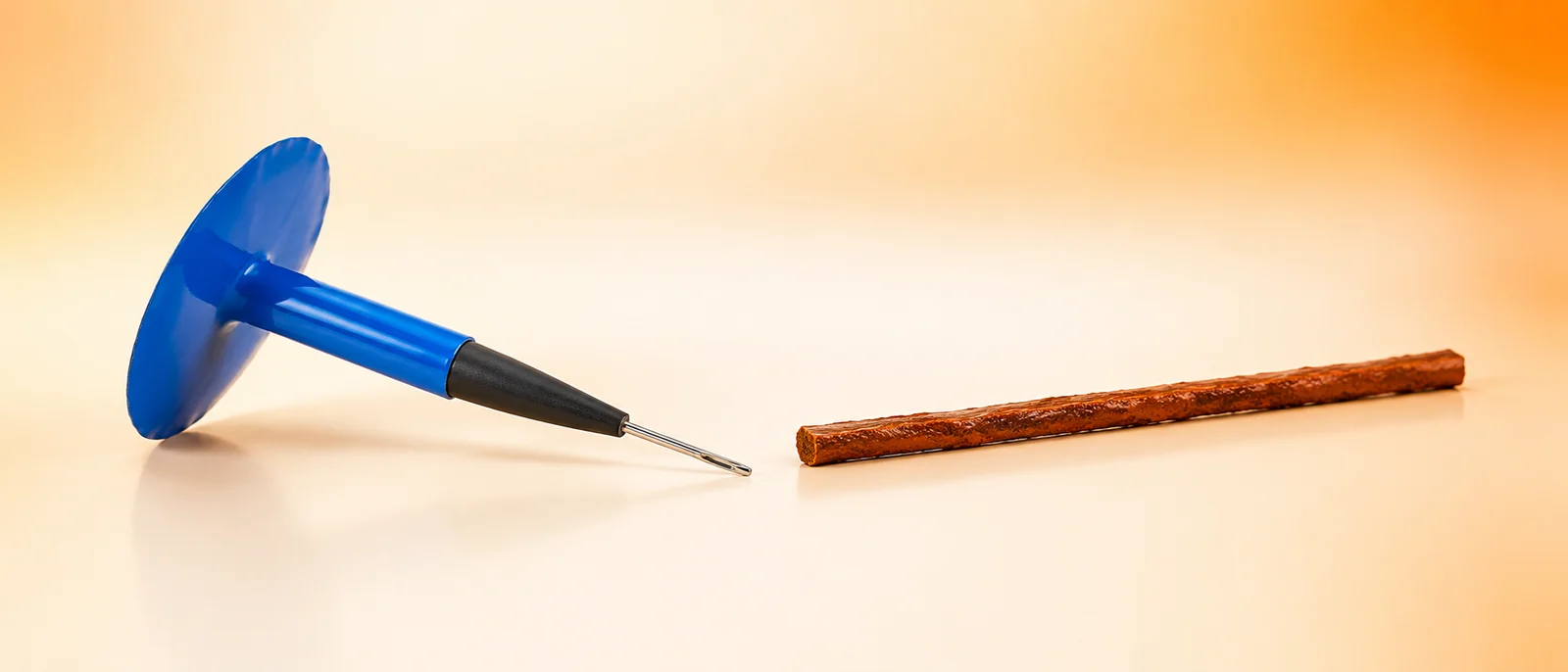
Two products dominate puncture repair, and they are often confused: the seal string and the mushroom patch plug. One is a fast temporary fix; the other is a permanent repair. Knowing which to use - and how to combine them - is the difference between a safe repair and an unsafe one.
The fundamental difference
| Feature | Seal string | Mushroom patch plug |
|---|---|---|
| Repair type | Temporary | Permanent |
| Fitted from | Outside the tyre | Inside the tyre |
| Seals | The puncture channel only | The channel and the inner liner |
| Bonds to liner | No | Yes (vulcanised) |
| Typical time | A few minutes at the roadside | Workshop job, tyre demounted |
| Best for | Getting to a workshop | A lasting, roadworthy repair |
How a seal string works
A seal string is a rubber strip pushed through the puncture from outside with a rasp and insertion tool. It fills the hole and creates an immediate seal, which is exactly what you want at the roadside. But it does not bond to the inner liner, so air and moisture can eventually work past it, and it does nothing to reinforce the damaged area from inside.
Use it for: small tread-area punctures, to reach a workshop safely, and as a spare-kit item. Full instructions are in our seal string repair guide.
How a mushroom patch plug works
A mushroom patch plug combines a stem and a patch in one piece. The stem is pulled through the puncture from inside so it fills the hole, while the round patch is bonded to the inner liner around the injury. It seals the puncture and reinforces the area in a single action, which is why it is regarded as the most reliable permanent repair for passenger car and light truck tyres.
Use it for: permanent repairs of repairable tread punctures. See the mushroom patch plug range.
Combining the two: the real-world workflow
- At the roadside, insert a seal string to stop the leak and get the vehicle to a workshop.
- At the workshop, demount the tyre and inspect the injury. If it is repairable, remove the string if necessary and fit a mushroom patch plug (or a radial patch) from the inside.
- If the injury is not repairable - sidewall, shoulder, exposed cords or too large - replace the tyre.
The seal string is the bridge to a permanent repair; it is never the final answer.
When a tyre cannot be repaired
- Damage in the sidewall or shoulder.
- Injuries where the cords are cut, exposed or separated.
- Punctures larger than the product is rated for.
- Tyres run flat and overheated, or with internal damage.
- Multiple or overlapping repairs.
Which should you stock?
Distributors and workshops should stock both: seal strings as a high-turnover roadside consumable and mushroom patch plugs as the permanent repair product. Pair them with tyre patches for repairable injuries that do not need a plug, and see our patch vs plug guide for the full decision tree. For a mixed repair-kit quote, contact our team.
- BS AU 159 (UK standard for the repair of car and light van tyres) - temporary versus permanent repair guidance
- Product specifications and repair ranges: Century Auto Parts published product data