
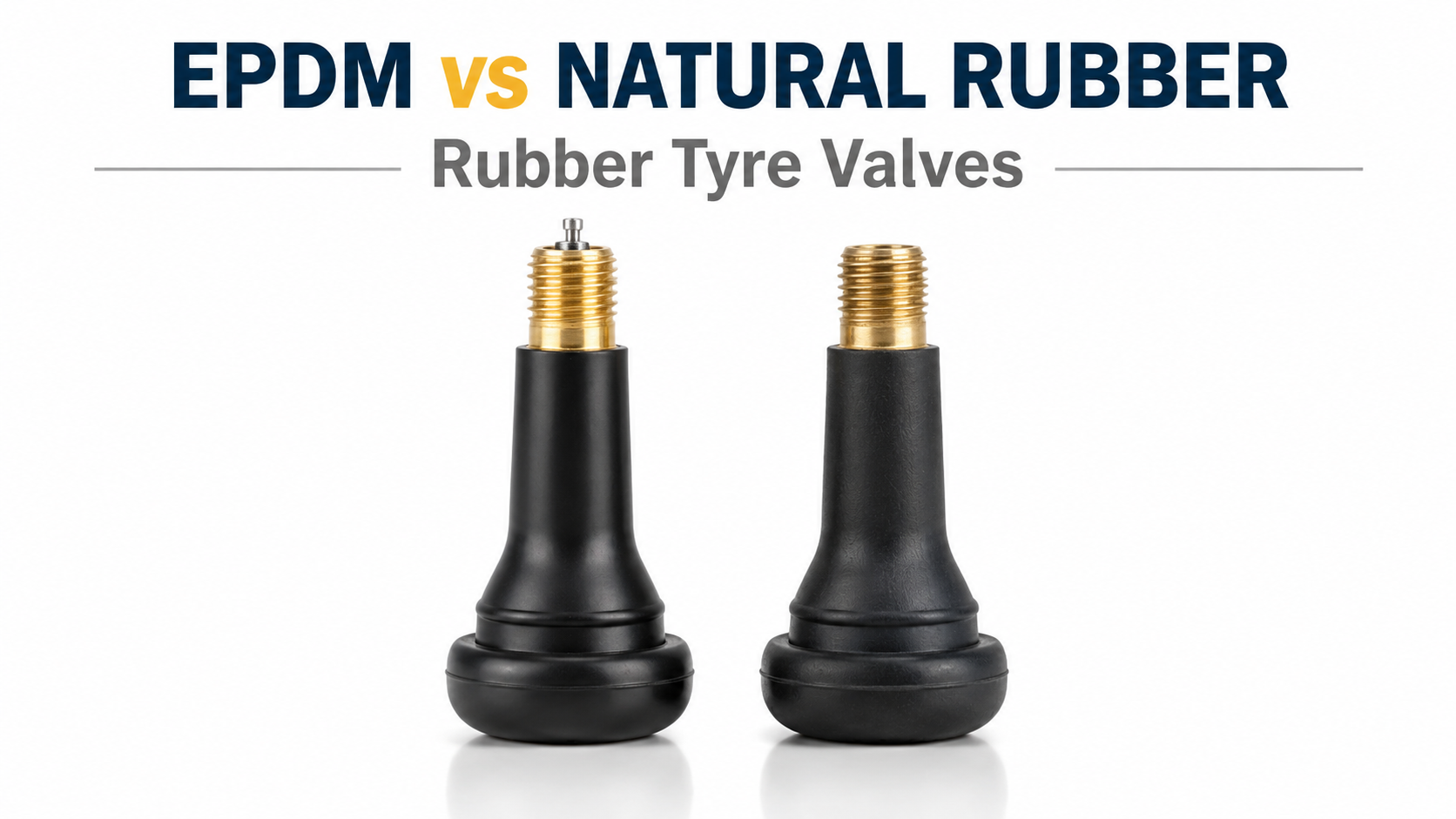
Rubber tyre valves are the most common valve type on passenger cars and light trucks - the familiar TR412, TR413, TR414, TR414C and TR415 series. The same-looking valve can have a very different service life depending on the rubber it is moulded from. The two main materials are EPDM (ethylene propylene diene monomer) rubber and natural rubber (NR). This guide explains how they differ, and which to choose for your market.
What the rubber does in a tyre valve
A rubber valve seals the rim hole of a tubeless tyre and holds the inflation pressure while the wheel flexes at speed. Because it sits outside the rim, it is exposed to ozone, UV light, rain, brake heat and temperature swings. Over years of service it must stay elastic and keep sealing - without cracking, hardening or leaking. The rubber compound is therefore the part that decides how long the valve lasts.
EPDM rubber: the long-life choice
- Superior ozone and UV resistance - EPDM's saturated backbone resists the ozone attack that cracks natural rubber. This is the single most important property for a valve that lives in the open air.
- Excellent heat resistance - EPDM withstands sustained temperatures above 120°C, so it survives brake heat and hot-climate roads without premature ageing.
- Low compression set - it stays soft and keeps its seal over time, so the valve does not deform or leak under pressure.
- Long service life - resists hardening, yellowing and cracking for many years.
This is why most quality and OEM rubber valves, and nearly all TPMS-compatible valve stems, are built with EPDM rubber.
Natural rubber: strong and flexible, but less durable outdoors
- Higher tensile and tear strength - natural rubber resists tearing during fitting and removal.
- Better resilience and softness - returns to shape quickly and feels more flexible.
- Good low-temperature performance - stays flexible in cold weather.
Potential cost advantage: natural rubber may have a raw-material cost around 20-50% lower than EPDM, depending on market prices, material grade, compound formulation and order volume. This is an indicative raw-material comparison, not a guaranteed finished-valve price difference; the final cost also depends on processing, bonding requirements and quality specifications.
However, natural rubber contains unsaturated double bonds, which make it vulnerable to ozone and UV cracking. Exposed to the elements, a natural rubber valve can harden, yellow and develop surface cracks sooner than an EPDM valve, potentially leading to slow leaks and a shorter service life.
Side-by-side comparison
| Property | EPDM rubber | Natural rubber (NR) |
|---|---|---|
| Ozone resistance | Excellent | Poor |
| UV / weather resistance | Excellent | Poor |
| Heat resistance | High (120°C+) | Moderate (~100°C) |
| Low-temperature flexibility | Good | Excellent |
| Compression set / sealing | Low (better seal) | Higher |
| Tensile / tear strength | Moderate | High |
| Resilience / softness | Moderate | High |
| Service life outdoors | Long | Shorter |
| Indicative raw-material cost | Baseline | May be 20-50% lower* |
*Indicative raw-material comparison only. Actual finished-valve pricing varies with market conditions, compound specification, processing, bonding requirements and order quantity.
Which should you choose?
For most passenger car, light truck and tubeless applications, EPDM rubber is the better long-term choice because a valve that refuses to crack and leak is what keeps a tyre safely inflated. Natural rubber valves remain an option where softness, high strength or cost sensitivity is the priority, but they need more care in hot, sunny and high-ozone environments.
Buying notes for distributors
- Specify the material on the order - EPDM and natural rubber valves can look identical, so the compound should be stated, not assumed.
- Confirm ozone and heat performance with your supplier, especially for hot-climate and high-mileage markets.
- Check the brass bond on EPDM valves - EPDM is harder to bond to brass than natural rubber, so ask about the vulcanising and bonding process.
- Stock both if your customers serve different price points, but position EPDM as the durable, long-life option.
We manufacture both EPDM and natural rubber valve series, including TR412, TR413, TR414, TR414C and TR415. For the full range, see our tyre valve types guide, or contact our team for a factory-direct quote.
- Ozone, UV and heat ageing behaviour of EPDM versus natural rubber - rubber industry material data
- Valve materials, dimensions and pressure ratings: Century Auto Parts published product specifications